Last updated on August 6th, 2026 at 09:13 am
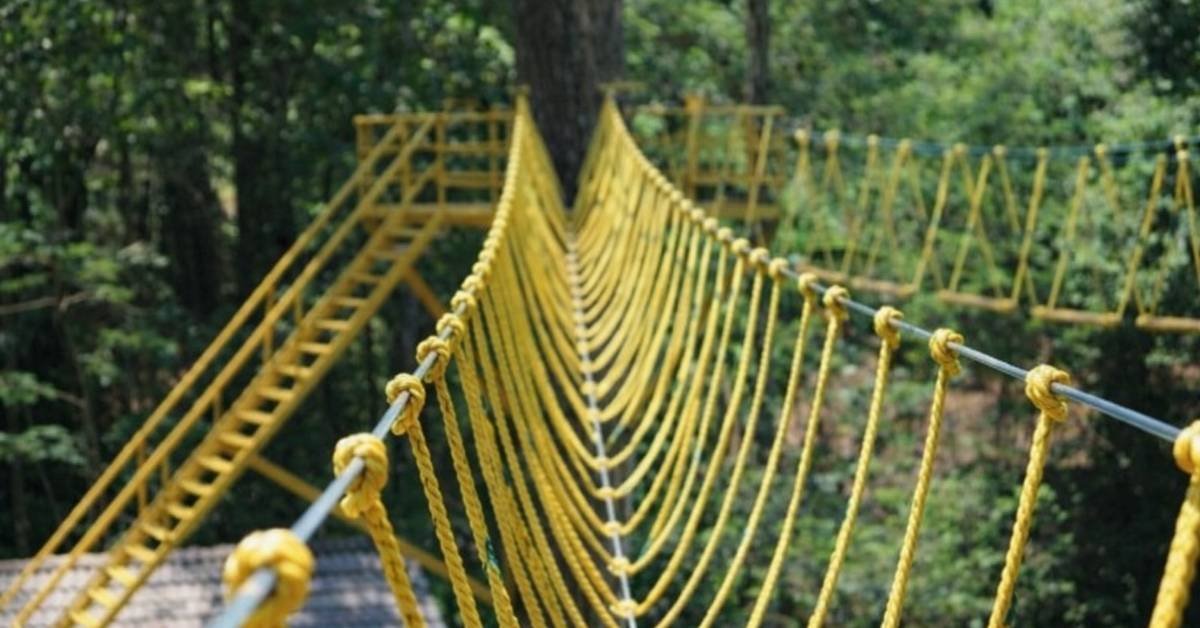
A Burma Bridge is a suspended rope bridge made of three ropes, one to walk on and two at chest height for support. It was first used by the British Army in World War II to move soldiers through Burma’s difficult mountain terrain. Today, it is one of the most popular adventure activities in India because it combines a real physical challenge with a manageable thrill for all age groups.
This guide covers everything you need to know about the Burma bridge: its military origins, how it is built, safety standards, weight and age limits, cost, and the top verified locations across India where you can actually try it.
No filler. Just the facts you need before you book.
The Origin: From World War II to Adventure Sport
The Burma Bridge has a direct military history. During World War II, the British Army needed a fast, lightweight way to move soldiers and supplies across rivers, gorges, and difficult mountain passes in Burma (now Myanmar). Standard bridges were too slow to build and too easy for the enemy to destroy.
The solution was simple but effective: a three-rope suspended crossing that soldiers could assemble quickly in the field. It worked, and it stuck.
Key design features that have stayed the same since WWII:
- 1 bottom rope acts as the walking surface, suspended between two anchor points
- 2 side ropes run at chest height on either side for balance and grip
- The V-shape sag between the ropes creates natural instability, which was a training feature, not a flaw
After the war, military training schools kept using it to build balance, focus, and nerve under pressure. Adventure camps picked it up in the 1980s and 1990s as a team-building tool.
Today it is a staple at outdoor camps, school trips, and corporate retreats across India because it delivers a genuine challenge without requiring any prior training or equipment skill.
How to Cross a Burma Bridge and Safety Rules
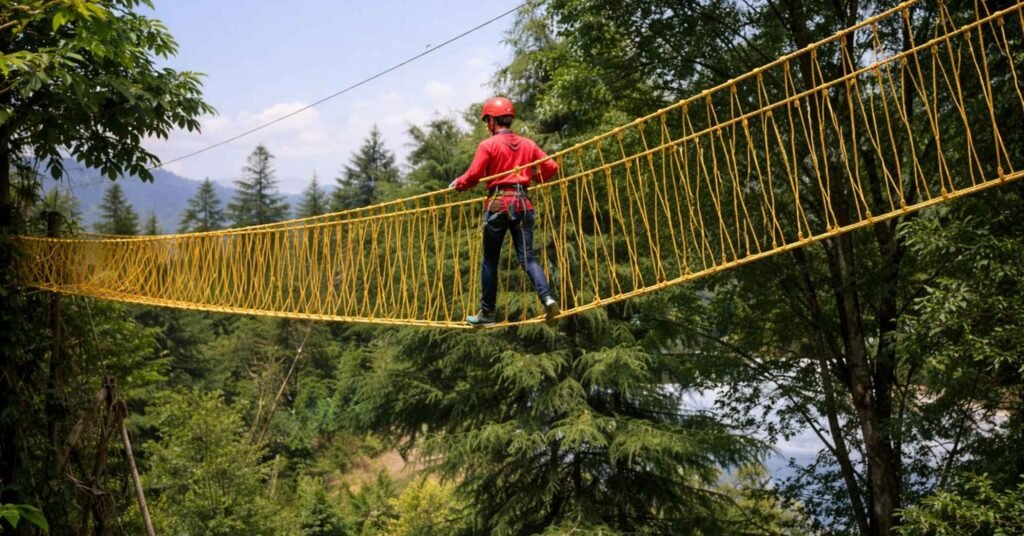
Fear of heights is the most common reason people hesitate before stepping on a Burma Bridge. That hesitation is normal. The bridge is designed to sway and dip, which triggers your balance instincts immediately. The good news is that most first-timers complete it once they understand what to expect.
Step-by-step guide to crossing:
- Step 1: Clip your harness to the safety line before stepping onto the bottom rope
- Step 2: Place one foot firmly on the bottom rope, then bring the second foot in line
- Step 3: Grip both side ropes at chest height, keep your elbows slightly bent
- Step 4: Walk slowly, heel to toe, looking straight ahead at the anchor point
- Step 5: At the midpoint, the V-shape sag will pull your feet closer together. Widen your grip on the side ropes slightly and keep moving
- Step 6: Never look straight down. Fix your gaze forward at all times
Standard Safety Checklist
| Equipment / Rule | Standard |
| Ropes | UIAA and CE certified only |
| Harness | Swiss-standard full body harness |
| Helmet | Mandatory for all participants |
| Weight limit | Up to 120 kg |
| Age limit | 8 to 65 years |
| Instructor | Certified ground instructor required |
Always verify that your activity provider follows certified safety standards. The Adventure Tour Operators Association of India (ATOAI) publishes guidelines for responsible adventure tourism in India.
Not Sure Where To Go!
Let our Random Country Generator help you discover your next perfect destination.
Use Our Free ToolTop Places to Experience the Burma Bridge in India (2026)
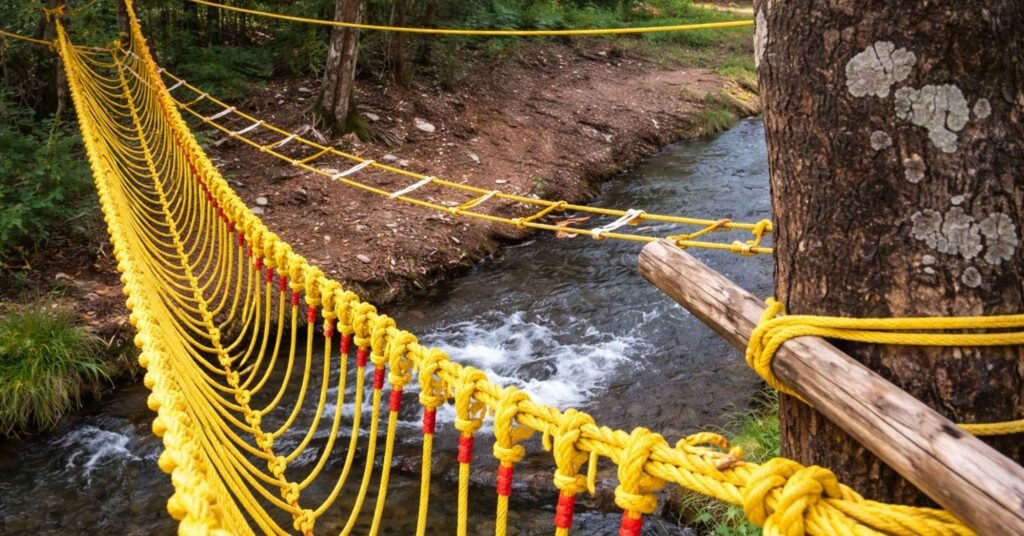
India’s mix of Himalayan foothills, river valleys, and central plateaus gives adventure camps a natural advantage. You get real elevation, real terrain, and real challenge without travelling abroad.
Here are four verified locations where you can experience a Burma Bridge in India right now.
Kanatal Adventure Camp, Uttarakhand
This is the most well-known Burma Bridge setup in India. The bridge sits 100 feet above the ground with double safety cables, making it one of the highest and best-rigged setups available at any Indian adventure camp.
The vibe is serious outdoor adventure surrounded by dense Himalayan forest. Great for groups, school trips, and anyone wanting a genuine height challenge.
Estimated cost: ₹300 to ₹500 for rope activities as a standalone activity. Check current packages on Uttarakhand Tourism’s official portal before booking.
Shivpuri River Rafting Camps, Rishikesh
Shivpuri is the adventure hub just outside Rishikesh, and most camps here combine Burma Bridge with river rafting packages. You get water and height in one trip.
The vibe is high-energy and social, popular with college groups and weekend travellers from Delhi and NCR. Rope activities are usually bundled into a full-day package.
Estimated cost: ₹300 to ₹500 for rope sport add-ons when booked as part of a rafting combo.
AAC (Achievers Adventure Camp), Nagpur
AAC runs a military-style obstacle course with 27+ individual obstacles, and the Burma Bridge is one of the centrepieces. This is not a casual tourist setup. It is built to simulate actual army training conditions.
The vibe is disciplined, structured, and physically demanding. Best suited for corporate team-building events, NCC groups, and serious fitness enthusiasts.
Estimated cost: ₹300 to ₹500 per activity, though full obstacle course packages are priced separately.
Peace Channels Resort, Dalhousie
Peace Channels Resort in Dalhousie offers a 60-feet suspended Burma Bridge as part of its adventure activity lineup. The Dalhousie setting adds pine forests and cooler temperatures to the experience.
The vibe is relaxed resort-style adventure, good for families and travellers who want a mix of comfort and mild outdoor activity.
Estimated cost: ₹300 to ₹500 for the Burma Bridge as a standalone activity.
What to Wear and What to Avoid on a Burma Bridge
Your footwear will make or break this experience before you even step onto the rope.
Most people show up to adventure camps in whatever they wore on the drive up. That’s the first mistake. The Burma Bridge does not care about comfort from the ground. It rewards preparation. Here’s the exact breakdown, no fluff.
Wear These — Non-Negotiable
- Closed-toe trekking shoes or sports shoes with deep rubber treads. The bottom rope is your floor. Your shoe’s grip is your grip. Deep treads bite into the rope and give you actual traction. Without them, you’re essentially walking on ice.
- Breathable, stretchable activewear. You will be reaching, adjusting your stance, shifting your weight side to side constantly. Rigid cotton jeans or stiff cargo shorts will restrict that movement at the worst possible moments.
- Full-length track pants or hiking trousers. This is non-negotiable for anyone who has never walked rope before. The bottom cable will scrape your shins and calves if you slip even slightly. Full-length pants are your only protection against that burn.
Strictly Avoid — Bring These and You Will Not Cross
- Flip-flops, crocs, or any open sandal. A complete non-starter. No legitimate camp will allow you on the bridge wearing these. The physics of gripping a rope with a flat rubber sandal and zero heel lock is dangerous.
- Skirts or extremely loose, billowing clothing. The safety carabiners on the overhead wire are not just a rope — they’re moving hardware. Loose fabric can and does snag on carabiner gates mid-crossing. Instructors will stop you at the platform.
- Dangling jewelry, lanyards, or any loose neckwear. If something catches on the overhead belay cable while you’re moving, you have a problem you cannot solve at height. Leave it all in your bag.
- Loose hair. The overhead cable has moving parts. Hair that is not tightly tied back can tangle in the system faster than you’d expect. A tight braid or a secure bun, no exceptions.
The gear check is not theatre. Every item on that avoid list has caused an actual on-site incident somewhere. Dress like you mean it.
Types of Burma Bridge Setups You Will Encounter
Not every Burma Bridge is the same structure. Camps across India use at least three distinct configurations, and each one demands a different approach. Knowing which one you’re about to cross changes your entire strategy.
The Classic 3-Rope Setup
This is the original design, still used in military obstacle training today. One thick steel-core bottom cable serves as your walking surface. Two side ropes run parallel at roughly chest height, your only handholds. The defining feature is the V-shape sag at the midpoint, where all three ropes dip significantly toward the center due to tension and gravity.
That V-sag is where the bridge earns its reputation. As you approach the middle, the handrails begin to pull inward and downward simultaneously. Your stance naturally widens, your grip tightens, and the sway increases because that’s where the rope has the most movement. Core balance is not optional here, it is the mechanism by which you continue forward. This configuration is found at high-altitude camps like Kanatal and in military-style obstacle circuits.
The Plank Bridge (Modified Burma)
Wooden planks, typically 1.5 to 2 feet wide, are secured horizontally across the bottom rope or across twin bottom cables running in parallel. The planks dramatically reduce the lateral sway and give your feet a flat surface rather than a round rope to balance on.
The difficulty curve drops significantly with planks. You lose the tactile feedback of gripping the rope with your shoe treads, but you gain a stable walking platform. This version is deployed at camps catering to families, school groups, and participants who are building basic confidence at height before attempting the raw 3-rope version. Do not write this off as easy; the height is identical. The floor just behaves better.
The Net Bridge Setup
Built on the standard 3-rope frame but with heavy-duty cargo netting woven between the walking rope and the two handrails. The net creates a tunnel-like enclosure around the participant.
Psychologically, this is the most forgiving version. Your peripheral vision of the drop below is partially blocked by the net’s weave. Participants who struggle with the visual exposure of the classic setup often perform significantly better on a net bridge because the brain receives fewer “danger” signals from the surroundings. The physical effort is similar to the classic setup, but the fear response is substantially lower. Camps use this version as an entry point for participants with strong height anxiety who still want to complete the crossing.
Why You Should Try the Burma Bridge
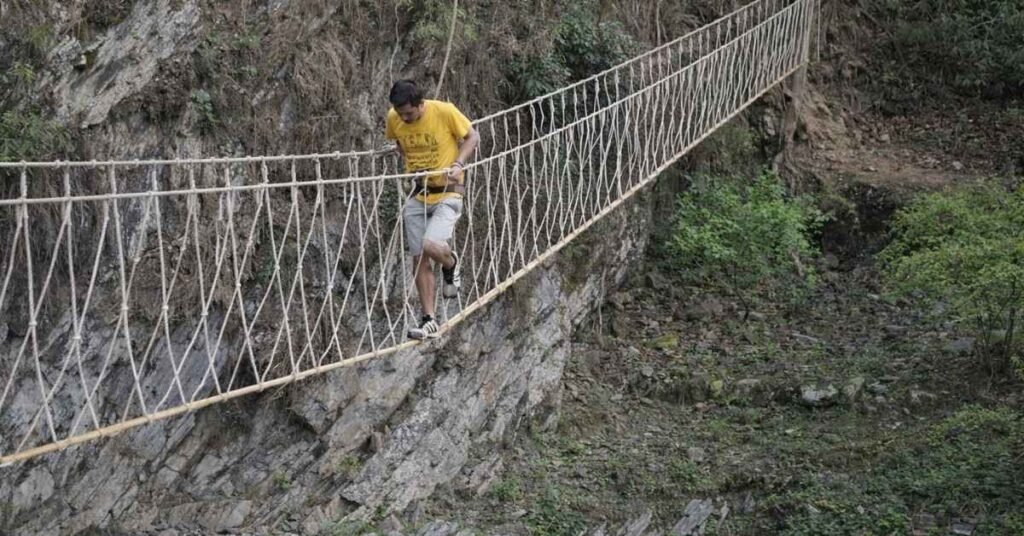
Corporate HR teams and school trip coordinators book this activity repeatedly because it delivers measurable results in a short time. It is one of the few outdoor activities where the challenge is visible, the outcome is immediate, and no prior fitness level is required.
Physical benefits:
- Builds core strength and balance as your body constantly adjusts to the swaying rope
- Improves grip strength and posture from holding the side ropes at chest height
- Engages your leg stabiliser muscles with every step on the bottom rope
Mental and team benefits:
- Forces you to confront and manage fear of heights in a controlled, safe environment
- When two people start from opposite ends simultaneously, it demands real-time communication and coordination
- Builds genuine confidence that transfers beyond the activity itself
One crossing takes under five minutes. The impact lasts longer.
Frequently Asked Questions
Is the Burma Bridge safe for kids?
Yes, it is generally safe for children aged 8 and above. All reputable camps provide properly fitted harnesses and keep a certified instructor on the ground throughout the activity.
What happens if I slip?
You will not fall. Every participant is clipped into a Swiss harness that connects to an overhead safety cable. If you lose your footing, the cable catches you immediately and holds you in place.
Can I do this activity during the monsoon?
It is not recommended. Wet ropes become slippery and significantly reduce grip and control. Most adventure camps officially suspend Burma Bridge operations during heavy rainfall for this reason.