Khab Sangam Bridge: The Dramatic Confluence of Spiti and Sutlej (2026 Guide)
Last updated on February 6th, 2026 at 12:15 pm
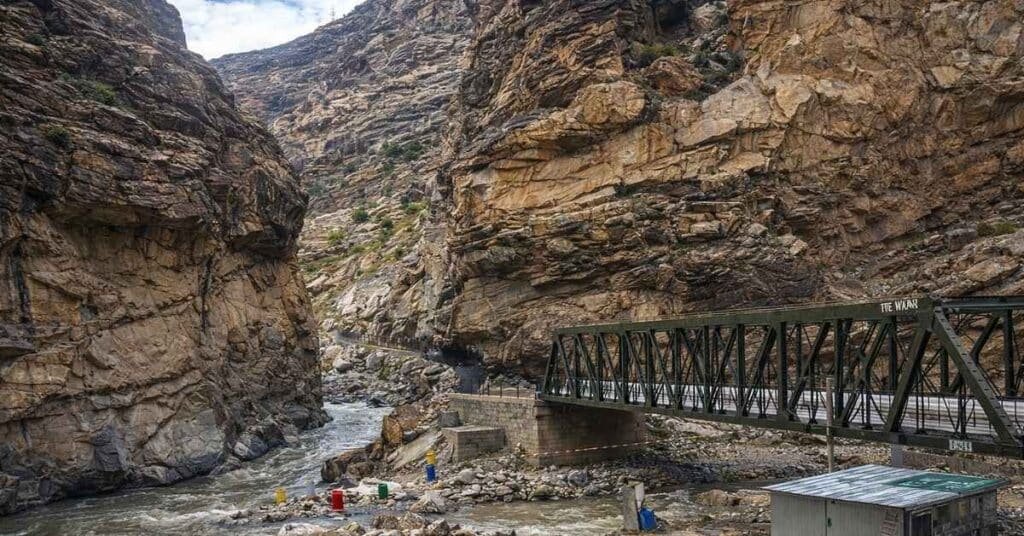
Imagine you are driving through the high, rocky mountains of Himachal Pradesh. For hours, you see green trees and apple orchards. Then, suddenly, the landscape changes. The trees disappear, and you are surrounded by giant, dusty brown mountains that look like they belong on another planet.
This is the gateway to the “Middle Land,” and right in the center of it is the Khab Sangam Bridge.
Khab Sangam is a special place in the Kinnaur district where two famous rivers meet: the Sutlej River and the Spiti River. It is a “Sangam,” which is a Hindi word for “confluence” or a meeting point. Standing on this bridge is one of the most exciting parts of a road trip to Spiti Valley. You get to see the powerful, muddy water of the Sutlej mix with the clear, turquoise water of the Spiti River.
As someone who has traveled these high-altitude roads many times, I can tell you that most people drive past this bridge too quickly. But if you stop for just ten minutes, you will feel the raw power of nature and see a view that you will remember for the rest of your life.
Khab Sangam at a Glance
Before we dive into the history and beauty of this place, here is a quick table of everything you need to know for your trip. This will help you plan your day perfectly.
| Feature | Details |
| Location | Near Khab Village, Kinnaur District, Himachal Pradesh |
| The Rivers | The Sutlej River and the Spiti River |
| Best Time to Visit | April to October (Winter is very cold and snowy) |
| Altitude | 2,800 meters (About 9,186 feet) |
| Nearest Fuel Pump | Pooh (About 12 km away) |
| Mobile Network | BSNL works best; Airtel/Jio are very weak here |
| Permit Required? | No permit for Indians; ILP required for Foreigners |
The Geography of the Confluence: Where Two Worlds Meet
To understand why Khab Sangam is so famous, you have to look at the two “characters” in this story: the rivers.
- The Sutlej River: This river is like a long-distance traveler. It starts all the way in Tibet near Mount Kailash. By the time it reaches Khab, it is big, powerful, and usually looks a bit muddy because it carries a lot of sand and rocks from its long journey.
- The Spiti River: This river comes from the high mountains of the Spiti Valley. It is usually a beautiful, clear blue or turquoise color. It is colder and calmer than the Sutlej.
When these two rivers hit each other at the Khab Sangam, it looks like a battle! For a few meters, you can actually see the blue water of the Spiti trying to mix with the brown water of the Sutlej.
The Giant Mountain: Reo Purgyil
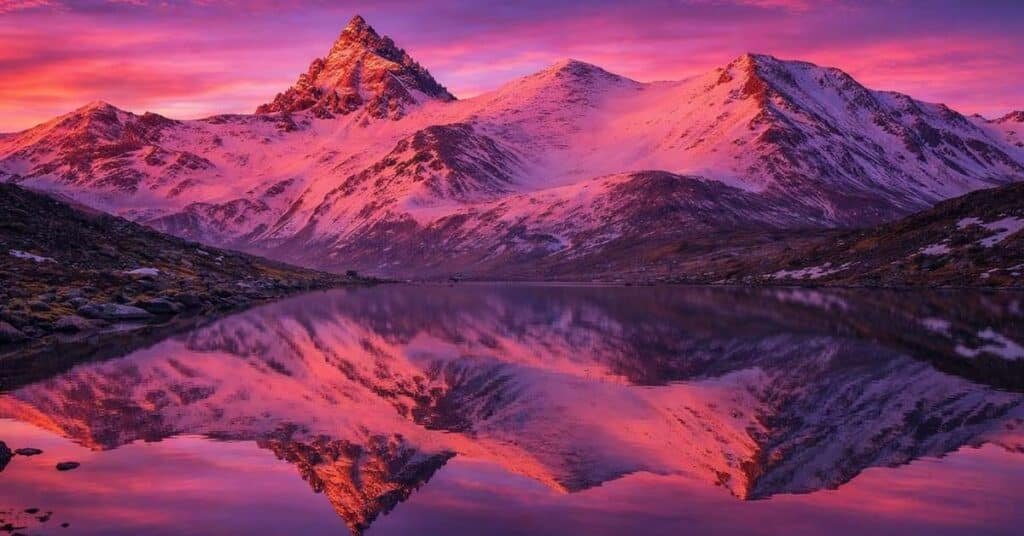
If you look up from the bridge, you will see a massive, snow-capped mountain towering over you. This is Reo Purgyil. It is the highest mountain peak in all of Himachal Pradesh! It stands over 6,800 meters tall. Having the highest peak in the state right behind the meeting of two massive rivers makes this spot feel very grand and tiny at the same time.
Standing on the Khab Bridge: An Engineering Marvel
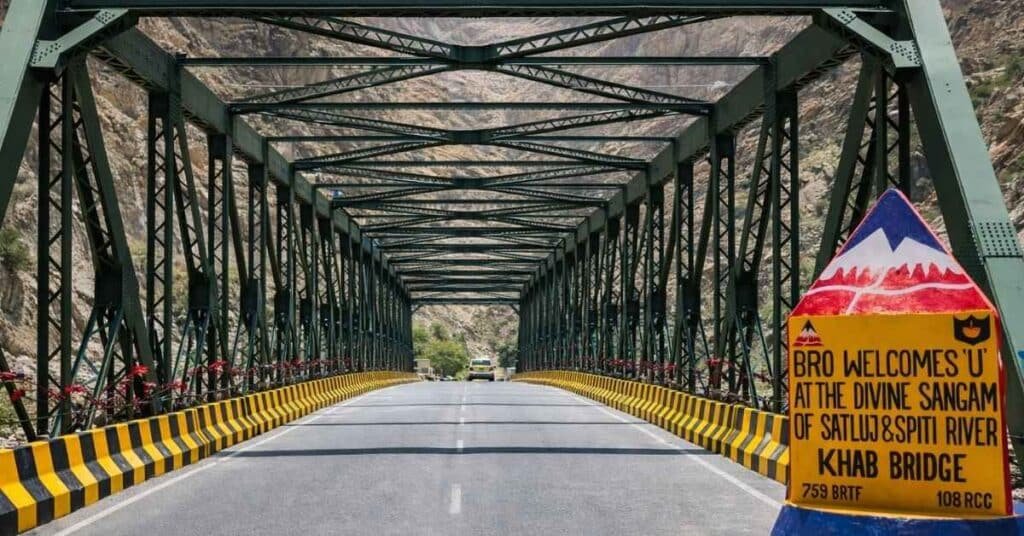
The bridge itself is a piece of art built by the Border Roads Organization (BRO). Because this area is so close to the international border, the bridge has to be very strong to carry heavy trucks and military vehicles.
When you step out of your car and walk onto the bridge, the first thing you will notice is the sound. The rivers are so powerful that they create a loud, constant roar that echoes off the giant canyon walls. It feels like the earth is vibrating under your feet!
The Old vs. The New
If you look closely near the current bridge, you might see the remains of the old bridge. In the past, traveling through here was much more dangerous. The new bridge makes the journey safer and smoother, but it still feels like an adventure because of how high you are above the water.
Photography Tips for Your Visit
If you want to get the best photo for your blog or Instagram, follow these simple tips:
- Stand in the middle: This gives you a clear view of where the two colors of the water meet.
- Look for the “V”: Try to frame the shot so the two rivers form a “V” shape coming together.
- Be careful of traffic: This is a main highway (NH-5), so always keep an eye out for trucks and bikes before you stop for a photo.
How to Reach Khab Sangam Bridge
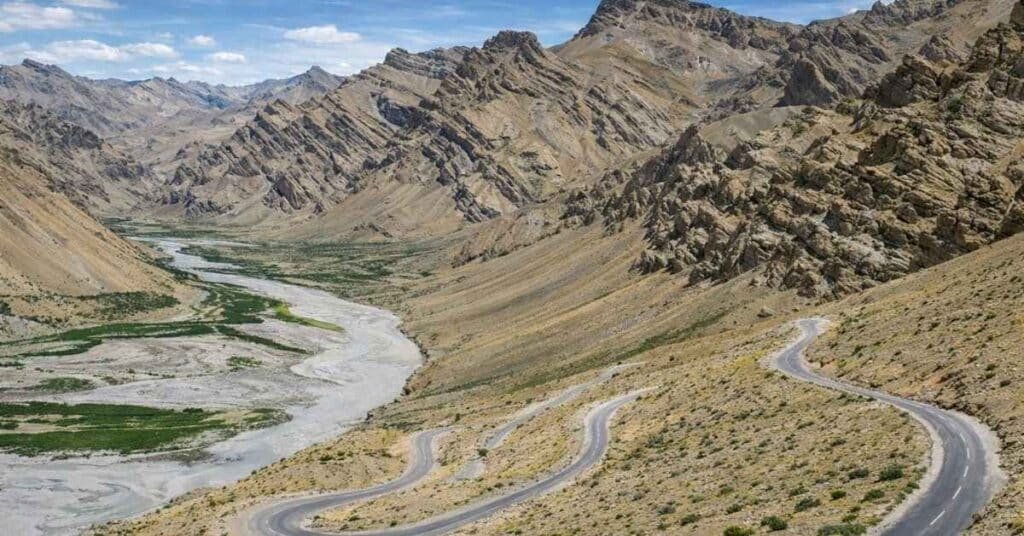
Getting to Khab Sangam is one of the most famous road trips in India. Most people visit this spot as they travel from the lush green forests of Shimla toward the dry, rocky deserts of Spiti Valley.
The Route from Shimla (The Most Popular Way)
If you are coming from Shimla, you will drive on the National Highway 5 (NH-5). This road is also called the Hindustan-Tibet Road.
- You will pass through beautiful towns like Rampur and Reckong Peo.
- After you pass a town called Pooh, the road starts to drop down toward the river.
- It takes about 10 to 12 hours to reach here from Shimla, so most travelers stay overnight in Kalpa or Reckong Peo first.
The Route from Kaza (Coming Down from Spiti)
If you are already in Spiti Valley and heading toward Shimla, you will reach Khab after passing through Nako.
- From Nako, the road goes through a series of sharp turns called the “Khab Loops.” * As you drive down these loops, you can see the bridge from high above. It looks like a tiny toy sitting between giant mountains!
Road Conditions: “The World’s Most Treacherous Road”
You might have heard that this road is one of the most dangerous in the world. While the BRO (Border Roads Organization) does a great job keeping it smooth, the road is carved into the side of massive cliffs. There are spots where the mountain “hangs” over the road like a roof!
Important Note: Always check the weather before you start. During heavy rains, stones can sometimes fall from the cliffs (called “shooting stones”), so it’s best to drive during the day when you can see clearly.
Inner Line Permits (ILP): Crucial Information
Since the Khab Sangam Bridge is very close to the international border with Tibet (China), there are some special rules about who can visit. Don’t worry, they are quite simple!
For Indian Citizens
If you are an Indian citizen, the news is great: You do not need a special permit to visit the Khab Sangam Bridge or the Spiti Valley.
- However, you must carry a valid Photo ID (like your Aadhaar Card, Driving License, or Voter ID).
- At some places, like the police check post in Dubling or Sumdo, the officers might ask to see your ID and write down your vehicle number. It only takes a minute!
For Foreign National Travelers
If you are visiting from another country, you must get a Protected Area Permit (PAP). This is often called an “Inner Line Permit.”
- Why? Because Khab is a “sensitive” border area. The government wants to know who is traveling so close to the border for safety.
- Where to get it? You can get this permit at the DC Office in Shimla, the SDM office in Reckong Peo, or even in Kaza.
- Important Rule: Usually, foreigners need to be in a group of at least two people to get this permit.
Pro Tip: If you are a solo foreign traveler, try getting your permit in Reckong Peo. The officers there are very helpful and can often help you join another group’s application.
Hidden Gems Near Khab (The Best Stops)
Since you are already in such a remote part of the world, you should definitely check out these spots that are just a short drive away.
The Village of Pooh
About 12 kilometers before the bridge (if you are coming from Shimla), you will find Pooh. It is a beautiful village filled with apricot and apple orchards.
- Expert Tip: Pooh is the last place where you will find a reliable petrol pump and a mechanic before you enter the deeper parts of Spiti. If your tank isn’t full, stop here!
Nako Village and Lake
Just a 20-kilometer drive up the mountain from the bridge is Nako. It is a high-altitude village that looks like it’s frozen in time. There is a sacred lake in the middle of the village and a very old Buddhist monastery that you can visit.
The Secret Viewpoints
If you are feeling energetic, don’t just stay on the bridge. Walk about 10 minutes up the old road (towards the village). From there, you can look down and see the entire “X” where the rivers meet. It is the best spot for a panoramic photo of the mountains and the bridge together.
Ka Village
Very few travelers know about Ka Village. It is a tiny, quiet place near Khab. If you visit, you will see traditional Kinnauri houses and get a real feel for how people live in these harsh but beautiful mountains.
Best Time to Visit & Weather Safety
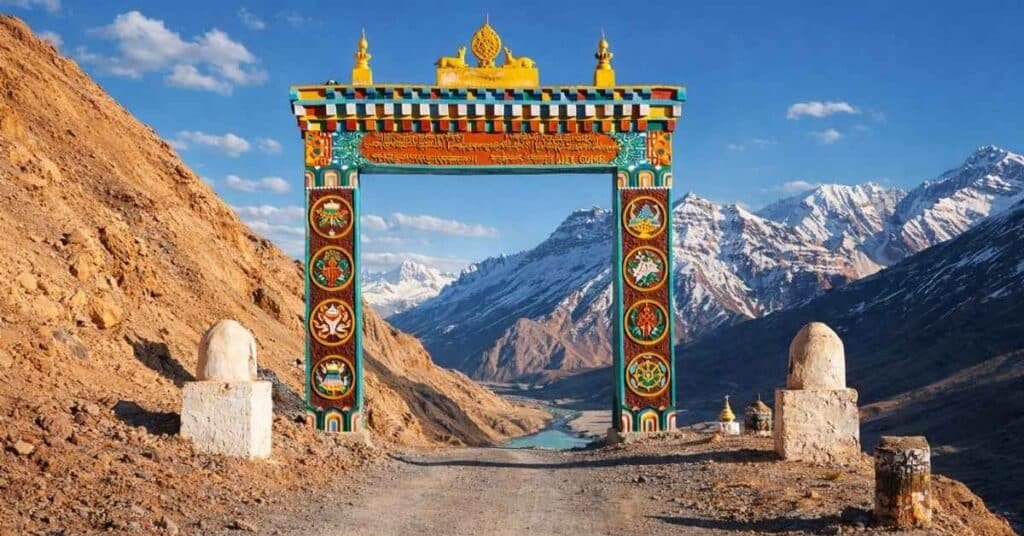
Choosing the right time to visit is very important because the weather in the mountains can change quickly. Since Khab is at a high altitude, it can get very cold, and the roads can be tricky.
The Best Months to Visit
- April to June (Spring & Summer): This is the most popular time. The weather is pleasant (not too cold), the roads are clear of snow, and the rivers are flowing beautifully.
- September to October (Autumn): If you like colors, this is the time for you! The sky is a deep blue, and the apple trees in nearby villages like Pooh start turning golden. The air is crisp and clear, making it perfect for photos of the giant Reo Purgyil peak.
Traveling in the Monsoon (July & August)
Be very careful if you plan to visit in July or August. This is the rainy season. While it doesn’t rain as much in Spiti, the road to get there (NH-5) can have landslides.
Safety Tip: Look out for “Shooting Stones.” These are small rocks that can fall from the cliffs above the road during or after rain. If you see signs that say “Landslide Prone Area,” don’t stop your car there!
Winter Travel (November to March)
During winter, Khab becomes a “White Wonderland.” The Spiti River can even start to freeze!
- Is it open? Usually, the road to Khab stays open because the army uses it.
- The Challenge: It is extremely cold (sometimes -15°C at night). Only visit in winter if you are prepared for heavy snow and very basic staying options.
Practical Travel Tips for the Conscious Traveler
Since this is a remote area, being prepared will make your trip much smoother. Here are some “insider tips” based on years of travel experience on these roads that will help you stay safe and comfortable.
Fuel Up at Pooh: I cannot stress this enough—the petrol pump at Pooh is your best friend. Sometimes the next pump in Kaza (about 100km away) can be out of fuel or have long lines. Always top up your tank here.
Carry Cash: There are very few ATMs in this region, and even when you find one, it might not have money or the internet might be down. Carry enough cash for your food, stay, and fuel.
Layer Your Clothes: Even in the middle of summer, the wind at the Khab Sangam Bridge can be very cold. Wear a windbreaker or a light jacket even if it feels sunny.
Stay Hydrated: You are at a high altitude (~9,000 feet). Drinking plenty of water helps your body adjust to the thin air and prevents altitude sickness.
Food Options: Don’t expect fancy restaurants at the bridge. There are small tea stalls (dhabas) that serve hot Maggi, tea, and biscuits. For a full meal, it is better to eat at Pooh or wait until you reach Nako.
Phone Network: Your mobile signal will likely disappear or become very weak at the bridge. Download your Google Maps for “offline use” before you leave Reckong Peo so you don’t get lost.
Why Most Travelers Miss the “Real” Khab
Most people treat Khab like a quick pit stop. They hop out of their car, take one photo of the bridge, and drive away. But if you do that, you are missing the best parts! Here is how you can experience the “real” Khab that most tourists never see.
The Hidden Vantage Points Above the Bridge
If you want the “postcard view” where you can see both rivers meeting perfectly, don’t stay on the bridge. Instead, drive or walk a little bit higher on the road toward Nako.
There are small, safe pull-out spots where you can look down. From up there, the bridge looks like a tiny thread, and you can clearly see the line where the blue Spiti water meets the brown Sutlej water. It is the best place for a panoramic photo that will make your friends say “Wow!”
The Old Road vs. The New Bridge
Before the big, strong bridge was built, travelers had to use a much smaller, scarier road carved right into the cliffside. If you look at the mountain walls near the bridge, you can still see parts of this old “Hindustan-Tibet” road.
Looking at that narrow path makes you realize how brave the early travelers and the BRO (Border Roads Organization) workers were. It’s a great reminder of how much history is buried in these rocks.
The Silence of the Border: Shipki La
When you stand at Khab, you are standing at the edge of India. Just a few kilometers away is Shipki La, a high mountain pass that leads directly into Tibet (China).
Because it is a border area, there are no loud markets or noisy crowds. There is a special kind of “border silence” here. You might see Indian Army trucks passing by or notice the high-altitude bunkers on the ridges. It feels very peaceful but also very serious, knowing you are at the very frontier of the country.
Frequently Asked Questions (FAQs)
- Is the Khab Sangam Bridge worth stopping for?
- Yes! It is one of the most unique geographical spots in India. Seeing two massive rivers meet in the middle of a desert canyon is a sight you won’t find anywhere else. Plus, it’s a great place to stretch your legs during a long drive.
- How far is Khab Sangam from Reckong Peo?
- It is about 75 kilometers (46 miles) away. However, because the roads are narrow and curvy, it usually takes about 3 to 4 hours to drive this distance.
- Can I see the China (Tibet) border from the bridge?
- Not exactly. While you are very close to the border (only about 10-15 kilometers away), the actual border line is hidden behind high mountain ridges. However, you will see many army vehicles and signs that remind you how close you are to the edge of the country.
- Are there any hotels or homestays at Khab Sangam?
- There are almost no places to stay right at the bridge. It is strictly a transit point. Most travelers choose to stay in Pooh (12 km away) or Nako (20 km away), where there are plenty of guest houses and homestays.
- Do I need a 4×4 vehicle to reach the bridge?
- No, a 4×4 is not required. The road (NH-5) is well-paved for the most part. Any car with good ground clearance or even a standard motorcycle can reach here easily during the summer months.
Final Thoughts: Why Khab Stays With You
The Khab Sangam Bridge is more than just a piece of concrete connecting two mountains. It is a place where you can feel the true scale of the Himalayas. Standing there, with the roar of the Sutlej in your ears and the giant peaks of Kinnaur above your head, you realize how small and beautiful our world really is.
Many people call the road to Khab “treacherous” or “dangerous,” but I prefer to call it transformative. It challenges you, but it rewards you with views that most people only see on postcards.
When you visit, don’t just snap a quick photo and drive away. Turn off your engine, step out of your car, and spend five minutes just watching the water flow. It is one of the few places left where you can truly hear the earth speaking.
Safe travels, and may your journey to the “Middle Land” be as wild and beautiful as the rivers of Khab!